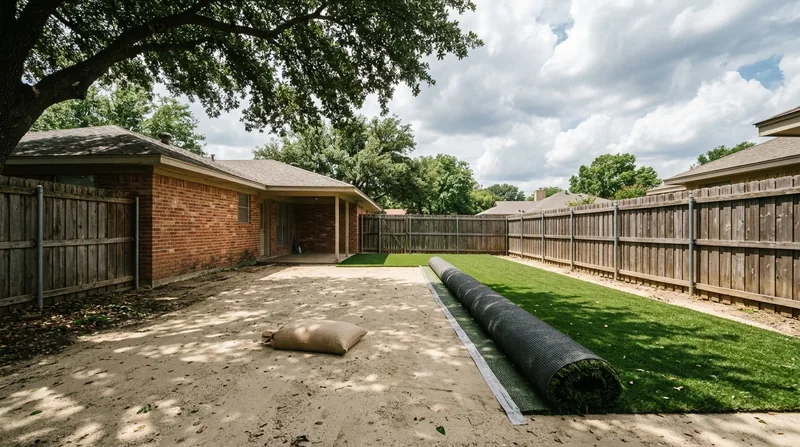




Irving yards face a singular challenge: the Residential Artificial Grass Installation that works here must handle black clay soil that heaves in summer, live oak shade that thins St. Augustine to bare patches, and 100-degree heat that stresses real grass from June through September. The brick ranch homes of south Irving, the planned neighborhoods of Las Colinas, and the canal-side estates of Valley Ranch all share the same problem: a healthy lawn dies faster than homeowners can replant it. We install dense, durable turf that stays green year-round, backed by a written specification of face weight, pile height, infill type and base depth before any work starts. Our process removes the failed sod and heaving clay, installs a compacted decomposed granite base pitched away from your slab, and pins the edges along cedar fences and brick beds so the turf stays put through Texas thunderstorms and summer heat. For a free estimate and honest guidance on whether artificial turf is the right answer for your yard, call (682) 214-9397 or visit our contact page.
Why Residential Artificial Grass Matters in Irving's Heat and Clay
Irving's climate and soil are unforgiving to natural turf. Summer temperatures regularly exceed 100 degrees Fahrenheit, and the black clay that dominates central and south Irving expands when wet and contracts when dry, cracking open by August and heaving sod right out of the ground. Live oaks and crape myrtles cast deep shade that St. Augustine and bermuda grass cannot tolerate for long, leaving bare patches under the canopy. Real grass also demands consistent water through the hot months, which drives utility bills and wastes water during drought cycles common to North Texas. Artificial turf eliminates these problems entirely: it stays green without watering, handles the heat without stress, and sits on a stable base that does not heave or crack.
- We remove the old sod and dig out heaving clay to a stable depth, preventing future settling and drainage problems.
- A compacted decomposed granite base is sloped away from your home's foundation and hardscape to shed water safely.
- Turf is pinned along fence lines, brick beds, and concrete edges so it stays in place during Texas hail and heavy rain.
- The finished yard is dense, green, and playable the day after installation, with no dead patches under trees or in full sun.
These steps ensure that your turf installation lasts for years without settling, pulling away from edges, or developing drainage problems that plague poor installations.
Key info: Irving's black clay soil is the number-one reason homeowners in south Irving, the Heritage District, and Las Colinas replace failed real grass with turf. A properly prepared base prevents the heaving and settling that ruins cheap installations and leaves you staring at gaps and low spots within two years.
For details on how we handle the specific challenges of Irving's terrain, see our residential artificial grass installation in Irving (75060) and our work in South Irving (75061), where clay problems are most severe.
For more information on permitting and HOA rules in Irving, the City of Irving's Development Services department can be reached at cityofirving.org, where you can submit plans for front-yard work if your neighborhood has architectural guidelines.
How We Install Residential Artificial Grass in Irving: Step-by-Step
Our installation process is built around Irving's clay soil and drainage demands. We start with a site visit to assess the yard's slope, any existing drainage issues, and whether the turf will sit in shade or full sun. We then remove the old sod, excavate to a stable depth (typically 4 to 6 inches), and haul away the heaving clay that causes problems in most Irving yards. The base layer is compacted decomposed granite, sloped away from your slab to shed water. Turf is laid in seams that are taped and glued, then edges are pinned along all hardscape and fence lines. Finally, we add infill (typically a blend of silica sand and recycled rubber, or antimicrobial zeolite for pet yards) and brush it into the pile so the turf stands upright and dense.
- We request a Texas 811 utility locate before any excavation so we do not cut irrigation lines, low-voltage lighting wires, or pet-fence cables.
- Old sod and clay are removed and hauled away, leaving a clean, stable base ready for compaction.
- Decomposed granite is spread, compacted, and pitched so water runs away from your home and pooling does not occur.
- Turf is laid, seams are sealed, and edges are secured with galvanized pins so the turf stays in place through weather and use.
- Infill is spread and brushed in, and the turf is rinsed and groomed to stand upright and look finished on day one.
The entire process typically takes one to three days depending on yard size and complexity, and your yard is ready to use immediately after installation.
Example: A 1,000-square-foot yard in Valley Ranch with a mature live oak and a brick patio required removal of failed bermuda, excavation of clay, a 4-inch compacted granite base pitched toward the street, and installation of 50-ounce turf with antimicrobial infill. The job took two days and cost within the mid-range for Irving. The homeowner saw no settling or edge lift after one full Texas summer.
For related services like pet turf and dog run installation, we use reinforced drainage and specialized infill to handle urine and waste.
| Approach | Description | Best for |
|---|---|---|
| Full Excavation and Base Prep | Remove old sod and clay, install 4-inch compacted decomposed granite base, slope for drainage, then lay turf and infill. | Yards with heaving clay, poor drainage, or failed real grass. Most common in Irving. |
| Shallow Install Over Existing Sod | If sod is thin and stable, we remove it, lay 2-inch base, and install turf. No excavation of clay. | Small yards, patchy areas, or yards where the existing soil is already compacted and stable. |
| Patio and Hardscape Transitions | Turf is installed flush with concrete or pavers, edges are pinned, and a draining underlay prevents water pooling at the edge. | Yards with patios, pool surrounds, or covered porches where turf meets hard surfaces. |
| Shade-Adapted Installation | We select turf with lower face weight and pile height, ensure drainage is excellent, and reduce infill depth under dense canopy. | Yards under mature live oaks or crape myrtles where sun is limited and moisture lingers longer. |
Residential Artificial Grass Installation Cost in Irving: What to Expect
The cost of residential artificial grass installation in Irving typically starts at $8 per square foot and ranges up to $12 to $15 per square foot depending on several factors. A 1,000-square-foot yard in Irving will generally fall between $8,000 and $15,000 before any special features like pet reinforcement or complex drainage work. Smaller yards of 400 square feet might cost $3,200 to $6,000. The price depends on the depth and type of base preparation required (clay removal and compaction cost more than a simple shallow install), the face weight and pile height of the turf selected, the infill type (standard silica sand blend, antimicrobial zeolite, or recycled rubber), and the complexity of edges, transitions, and hardscape integration.
Irving yards with severe clay heaving, mature trees requiring careful excavation, or complex drainage problems will sit at the higher end of the range. Yards with good existing drainage and minimal tree interference cost less. We always recommend getting two or three estimates from different installers so you can compare the written specifications (turf product name, face weight, pile height, infill type and pounds per square foot, and base depth) rather than price alone. A cheap estimate that skips base preparation or uses low-grade materials will fail within a few years and cost you twice as much to replace.
For detailed pricing examples and a breakdown by yard size, visit our full pricing page. Call (682) 214-9397 for a free on-site estimate that includes a written spec before any commitment.
What to Look for When Hiring a Turf Installation Company Near Me in Irving
Artificial grass installation is not regulated like concrete or electrical work in Texas, but that does not mean all installers are equal. A bad installation costs you money twice: once upfront, and again when you have to replace it a few years later because seams split, edges lift, or the base settles and leaves low spots. When vetting any turf installer in Irving, North Irving, Las Colinas, or South Irving, ask for a certificate of insurance naming general liability and workers' compensation coverage, a written specification that names the turf product, face weight, pile height, infill type and pounds per square foot, and base depth, and a local address and phone number so you can reach them if something goes wrong. Call their references and ask to see photos of finished work from at least two years prior so you can see how the turf has held up. If the installer will not provide a written spec before the job starts, or quotes a price per square foot without seeing your yard, look elsewhere. We provide all of this as standard, and you can contact us for a free estimate with no obligation to book.
If your home is in an HOA community (common in Las Colinas, Valley Ranch, and parts of south Irving), check your architectural guidelines before you start. Front-yard turf color, pile height, and how much of the yard can be turf are often restricted. We help homeowners prepare HOA submittals and understand the rules, but we cannot promise approval. If your yard has protected or heritage trees, check with the City of Irving's Development Services to see whether a permit is required before any work that affects the tree or its root zone. For most residential turf installations, no city permit is needed, but it is always smart to ask first.
Residential Artificial Grass Installation in Irving: Pricing Guide
| Service | Price | Details |
|---|---|---|
| Standard residential installation | Starting at $8/sq ft | Full excavation, compacted granite base, turf, seams sealed, edges pinned, standard silica sand infill included |
| Shallow install or small area | Starting at $8/sq ft | Minimal clay removal, 2-inch base, best for stable yards under 500 square feet or patchy repairs |
| Pet turf with reinforced drainage | Starting at $10/sq ft | Antimicrobial zeolite infill, enhanced drainage layer, sealed seams, handles urine and waste without odor |
| Complex or large-scale job | On estimate | Severe clay heaving, mature tree excavation, multiple hardscape transitions, or drainage redesign require site assessment |
| Travel and free estimate | Included | No mileage charge for Irving, North Irving, Las Colinas, South Irving within service area |
Indicative pricing, the exact cost depends on square footage, finish, and site access. Free personalized estimate within 24h at (682) 214-9397.


