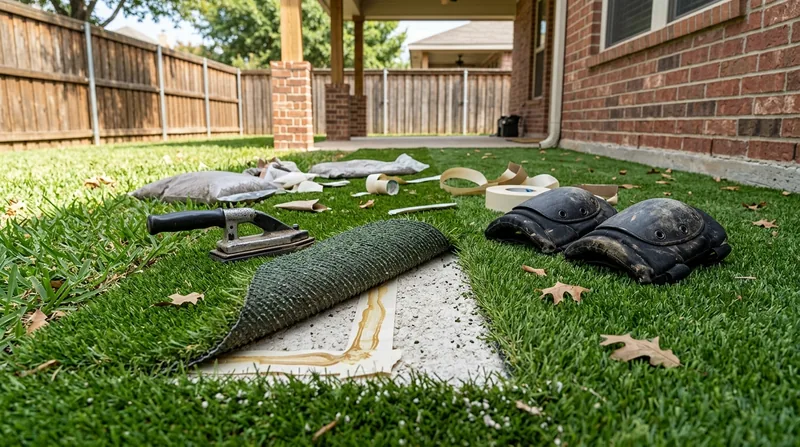




Irving's blackland prairie soils and intense summer heat create distinctive challenges for installed artificial turf. When seams split under 100°F temperatures, edges lift after spring thunderstorms, or fire-ant mounds push up beneath the backing, turf repair and seam repair in Irving becomes essential to protect your investment. The clay-heavy terrain that dominates south Irving and Valley Ranch shifts seasonally, settling unevenly and leaving low spots where water pools or the turf sags. Our turf installation company handles these failures with re-gluing, re-nailing, re-leveling from the base, and documentation for insurance claims, keeping your turf flat, sealed and performing for years to come.
Why Seam and Edge Failures Happen in Irving's Climate
Irving summers push surface temperatures to 140°F and beyond, causing polyethylene and polyurethane adhesives to soften and seams to separate. Spring hail and heavy runoff from the clay-based landscape erode base material and lift edges, especially on north-facing yards where drainage is already slow. Fire ants build mounds under turf backing, creating voids that cause the surface to sink and the seam to flex. These are not installation defects, they are the natural stresses of the Irving climate, and they happen to quality turf when base prep and ongoing monitoring are not in place.
- Seams open when summer heat weakens the bond between turf panels, allowing water and debris to enter the backing.
- Edges curl and lift when storm runoff erodes the base or when the clay soil beneath settles unevenly.
- Low spots develop where fire-ant activity, soil movement, or drainage failure creates voids under the turf.
- Melt marks and flattened areas appear where window reflections concentrate heat or where foot traffic compresses infill over time.
Addressing these issues early prevents water intrusion, mold, and further deterioration of the base and backing.
Key info: In Las Colinas and Valley Ranch, where mature oak trees create dappled shade and condensation pools beneath the canopy, seam stress is often compounded by poor air circulation and standing water. We photograph all repair work so you have documentation if your homeowner's insurance needs to assess storm damage.
How We Repair and Reseal Turf in Irving
Turf repair begins with a site inspection to identify the root cause, whether heat-driven seam separation, foundation settlement, drainage failure, or pest activity. We remove the failed section, clean the backing and base, re-level the foundation if needed, and re-glue and re-nail the seam rather than simply taping over it. For sunken areas, we excavate, compact fresh base material, and re-lay the turf to restore grade. For storm-damaged turf, we photograph the damage and provide a written report for your insurance claim.
- We inspect the seam, backing, and base to confirm whether the failure is adhesive breakdown, foundation movement, or moisture intrusion.
- We remove the damaged section of turf and backing, exposing the base and allowing us to assess compaction and drainage.
- We clean the turf backing with a wire brush and prime it with fresh adhesive to ensure a strong bond.
- We re-glue the seam using a polyurethane or polyester seam tape rated for the turf weight and the Irving heat load.
- We re-nail the seam with stainless steel fasteners every 6 inches to lock the panels and prevent future separation.
- We re-level low spots by adding and compacting base material, then re-laying turf to match the surrounding grade.
- We photograph all work, including before, during, and after images, and provide a written summary for your records.
Once the repair is complete, we recommend rinsing the seam area and allowing the adhesive to cure for 24 to 48 hours before foot traffic resumes.
Example: A homeowner in South Irving noticed a 3-foot seam separation along the west edge of their backyard turf after a hail storm. The turf was laid on 4 inches of compacted base, but the clay beneath had settled unevenly, creating a low spot. We removed the failed section, added fresh base material, re-compacted to grade, re-glued the seam, and re-nailed it. The repair held through the following summer and is now part of our portfolio for residential artificial grass installation in Irving.
| Repair Approach | Description | Best For |
|---|---|---|
| Seam Re-Gluing and Re-Nailing | Remove old adhesive, clean backing, apply new polyurethane seam tape, and fasten with stainless steel nails every 6 inches. | Heat-driven separation, adhesive failure, or seams that have been taped over without proper foundation work. |
| Base Re-Leveling | Excavate low spots, add and compact fresh base material, and re-lay turf to restore proper grade and drainage. | Sunken areas caused by soil settlement, fire-ant activity, or inadequate initial compaction. |
| Edge Lifting and Anchoring | Re-secure lifted edges with landscape spikes or re-glue to the perimeter, ensuring proper tension and preventing curling. | Storm damage, erosion of base material at yard edges, or turf that has shifted due to water runoff. |
| Storm Damage Documentation | Photograph damage, measure affected area, assess cause, and provide written report suitable for homeowner's insurance claim. | Hail, wind, or water damage where insurance coverage may apply and you need professional documentation. |
| Infill Refreshing | Add fresh infill to areas where material has compacted or migrated, restoring cushion and drainage performance. | High-traffic zones, pet areas, or yards where infill has settled and the turf feels hard underfoot. |
Turf Repair and Seam Repair Cost in Irving: What to Expect
Seam repair in Irving starts at around $350 for a small isolated failure, but the final cost depends on the length of the seam, the depth of base work required, and whether the failure is adhesive breakdown or foundation settlement. A 20-foot seam that requires only re-gluing and re-nailing may run $400 to $600, while a low spot that needs excavation, base replacement, and re-leveling can reach $800 to $1,200 or more. Storm damage repairs are often covered by homeowner's insurance if the turf is less than 10 years old and the base was properly installed. We recommend getting a site estimate before committing, because the cost difference between a surface seam fix and a base-level repair is substantial.
Factors that affect repair cost include the length and location of the seam, whether the base needs re-compaction or replacement, the size of any sunken area, access to the repair zone, and the urgency of the work. On a clay-heavy lot in south Irving or Valley Ranch, settling is common and may require periodic re-leveling. Visit our pricing page for detailed cost ranges and a breakdown of what drives the final estimate.
What to Look for When Hiring a Turf Repair Company Near Irving
Choosing a turf repair company is as important as choosing the original installer. Look for a local, independent turf installation company that names the product, face weight, pile height, and infill in writing, and that can show you photos of finished repair work. Verify that the company is fully insured with a certificate of general liability and workers' compensation coverage. Ask for references from Irving, North Irving, Las Colinas, and South Irving homeowners whose turf has been repaired, and request before-and-after photos of similar seam or base repairs.
- Request a certificate of insurance naming general liability and workers' compensation before work begins.
- Ask for a written estimate that specifies the repair method, materials, and labor cost, not just a lump sum.
- Request references from local Irving homeowners and ask about durability of the repair and how the company handled any follow-up issues.
- Confirm that the company photographs all work and provides you with a written summary for your records and insurance claim.
- Avoid companies that promise to tape over seams without re-gluing and re-nailing, or that claim to repair base issues without excavation.
- Check whether the company is willing to inspect the original installation and explain what went wrong, so you understand the failure and can prevent it in the future.
If your turf is in an HOA community in Las Colinas or near the Heritage District in south Irving, confirm that the repair method and any color matching comply with architectural guidelines before work starts. Contact us at (682) 214-9397 for a free estimate, and we will send a qualified technician to assess the damage and recommend the right repair approach.
Turf Repair & Seam Repair in Irving: Pricing Guide
| Service | Price | Details |
|---|---|---|
| Seam Re-Gluing and Re-Nailing (per linear foot) | Starting at $20-$30 | Includes adhesive removal, backing cleaning, new seam tape application, and stainless steel fastening every 6 inches |
| Low Spot Re-Leveling (per affected area) | Starting at $400-$800 | Includes excavation, fresh base material, compaction, and re-laying turf to restore proper grade and drainage |
| Edge Lifting Repair (per linear foot) | Starting at $15-$25 | Includes re-securing lifted edges, adding base material if needed, and re-anchoring with landscape spikes or adhesive |
| Storm Damage Documentation and Assessment | Starting at $150-$300 | Includes photography, measurement, damage cause assessment, and written report suitable for homeowner's insurance claim |
| Complex or Large-Scale Repair | On estimate | Multiple seams, extensive base work, or repairs requiring equipment access warrant an on-site inspection before pricing |
| Estimate and Site Visit | Free | Response within 24 hours at (682) 214-9397, no obligation to book, includes written summary and repair recommendation |
Indicative pricing, the exact cost depends on square footage, finish, and site access. Free personalized estimate within 24h at (682) 214-9397.


